StubHub Fees for Selling Tickets in 2026
Published August 27, 2026
Learn stubhub fees for selling tickets in 2026 compare payouts and discover faster fee free alternatives with WeBuyTickets today
StubHub Fees for Selling Tickets in 2026
If you’re trying to unload extra tickets, the biggest question usually isn’t just “Will they sell?” It’s “How much money will I actually get after fees?” That’s why so many fans, season ticket holders, and last-minute sellers dig into StubHub fees for selling tickets before they list anything.
The short version: StubHub does not charge a flat public seller fee anymore. Instead, seller fees can vary based on factors like ticket price, event timing, market demand, and other marketplace conditions. That makes your payout less predictable than many casual sellers expect.
For some people, that’s fine. For others, especially if you need cash fast or don’t want to babysit a listing, the traditional marketplace model can feel slow, uncertain, and expensive.
In this guide, we’ll break down how StubHub selling fees work in 2026, what they mean for your final payout, and why more ticket holders are choosing a direct-sale option like WeBuyTickets when they want speed, simplicity, and guaranteed results.
What StubHub Charges Sellers in 2026
StubHub says it is free to list tickets. The fee comes out only if the tickets sell. That part sounds simple enough.
What’s less simple is that there is no fixed seller commission publicly posted as a universal rate. According to StubHub’s own support content, sell fees may change over time and can adjust based on factors like:
Ticket price
Time left before the event
Updated event information
Supply and demand
So if you’re searching for a neat, universal answer to StubHub selling fees, you probably won’t find one. Instead, your actual fee is typically revealed through the payout details shown during the listing process or in your sale details after a sale.
What that means in practice
When you list tickets on StubHub, the platform generally shows:
Your asking price per ticket
Your expected payout
A fee breakdown or payout explanation
That payout is what matters most, because it reflects what you’ll really receive after the fee is deducted.
The key takeaway
With StubHub, the seller fee is not the upfront problem. The real issue is payout uncertainty.
You may know what you want to charge, but until you see the net amount, you don’t fully know what you’re earning.
Why Sellers Get Frustrated With Marketplace Fees
Competitor articles tend to focus on whether the fee is 10%, 15%, or something close. But that misses the bigger frustration.
For most casual sellers, the pain points are usually these:
Seller Concern | What Happens on a Marketplace |
|---|---|
Unclear final payout | Fees are deducted from the sale price |
Need money quickly | You must wait for a buyer |
Last-minute sales pressure | Demand may exist, but time is limited |
Extra effort | You manage listing, price, updates, and delivery |
Risk of issues | Seller penalties may apply if obligations aren’t met |
This is where the real comparison should happen. It’s not just about the percentage. It’s about the entire selling experience.
How StubHub Seller Fees Affect Your Actual Payout
A lot of sellers make the mistake of focusing only on the list price.
But your list price is not your payout.
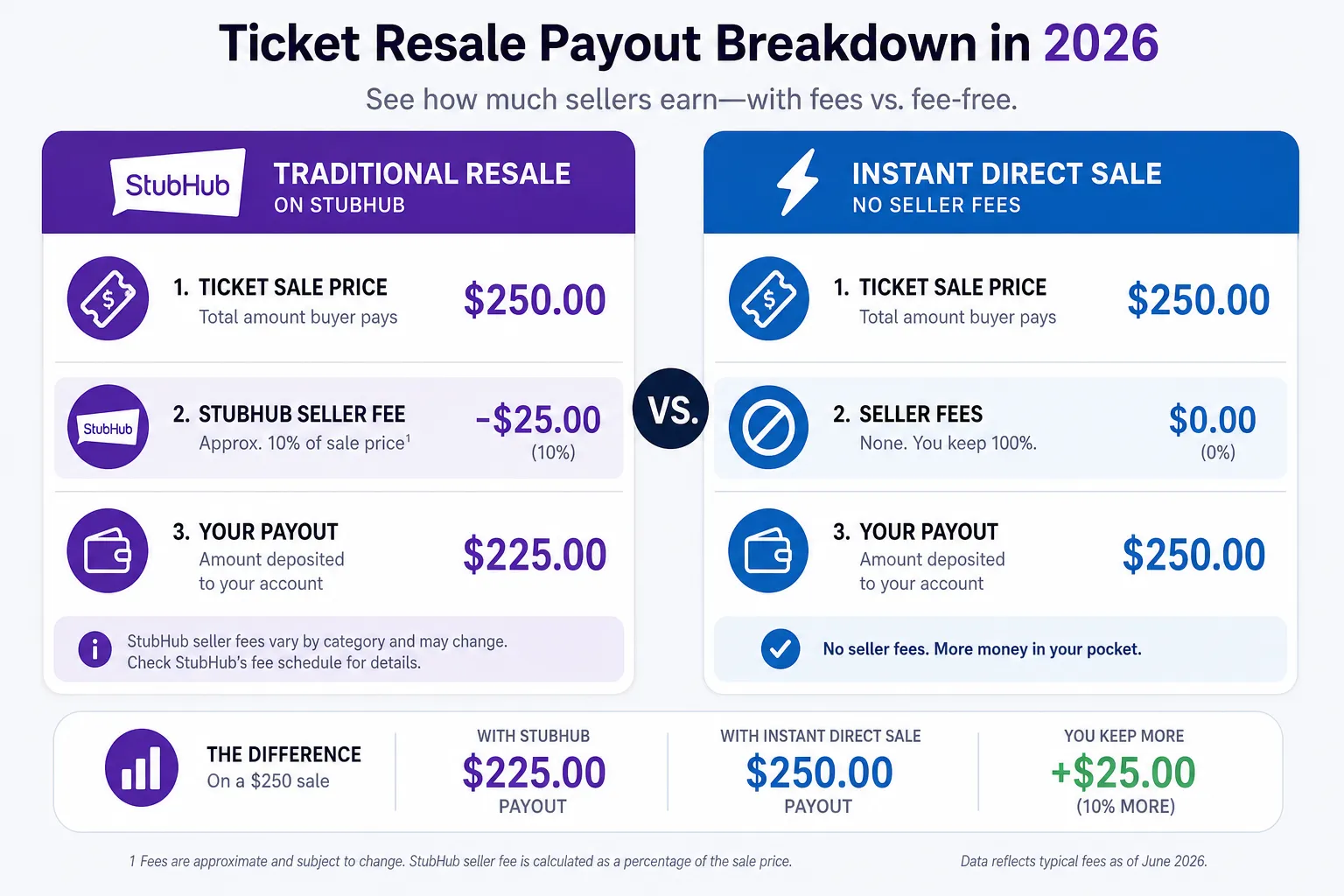
If you list a ticket for $200, you won’t necessarily receive $200. StubHub deducts its seller fee from the sale, which lowers your take-home amount. Depending on the event and pricing environment, that difference can be meaningful, especially when you’re selling multiple seats or expensive tickets.
Simple payout mindset
Ask these questions before you list:
What is my total expected payout?
How long am I willing to wait?
What happens if the tickets don’t sell?
Can I still sell them if the event is very close?
Is the extra effort worth the difference?
That’s a much smarter approach than obsessing over the sticker price alone.
Is StubHub Expensive for Sellers?
That depends on how you define expensive.
If you only care about getting exposure in a large marketplace, StubHub can still be useful. But if you define cost as time + uncertainty + fees + risk, then yes, it can become expensive fast.
Direct costs
Seller fee deducted from your sale
Potential pricing pressure from competing listings
Possible penalties if you fail to deliver as promised
Indirect costs
Waiting days or weeks for a buyer
Monitoring and adjusting your listing
Stress when the event is approaching
Losing leverage if you need to sell quickly
That’s why many ticket holders eventually realize that the problem isn’t only StubHub fees for selling tickets. It’s that the whole process can feel unpredictable.
StubHub Penalties Matter More Than Many Sellers Realize
This is one of the biggest content gaps in competitor coverage.
Most fee articles mention commission, but not enough explain the risk side of selling on a marketplace.
If you don’t fulfill your seller responsibilities, StubHub says you may be charged whichever is greater:
100% of the price of the tickets sold, or
The full amount incurred to remedy the issue for the buyer
That may include replacement ticket costs, vouchers, or shipping-related expenses.
Why this matters
If everything goes smoothly, the seller fee may be your only selling cost.
If something goes wrong, your costs can become much larger than the original commission deduction.
For casual sellers who aren’t professional brokers, that risk is a big deal.
How StubHub Compares to a Direct Buyer Model
This is where WeBuyTickets stands apart.
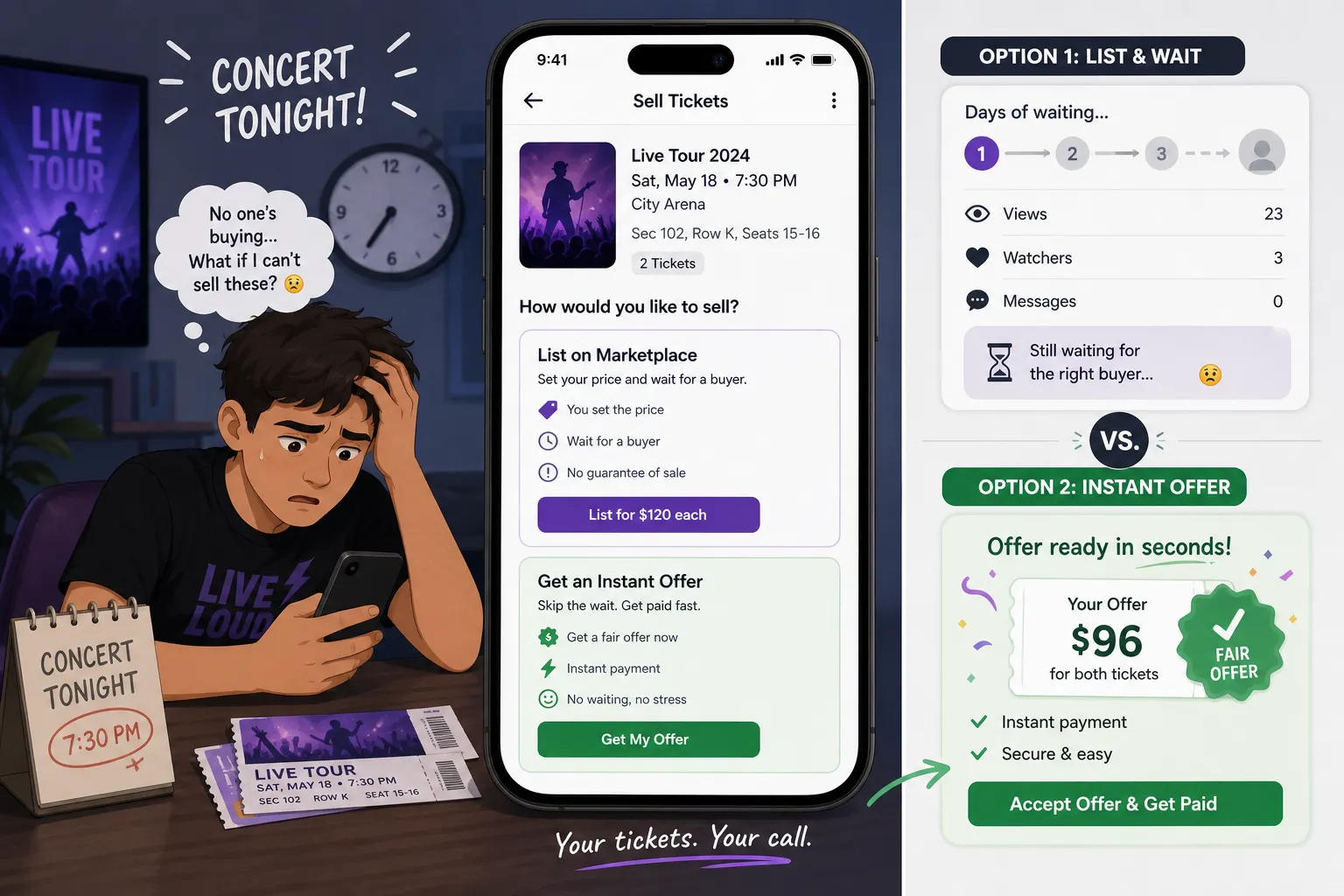
Instead of acting like a marketplace that waits for a buyer, WeBuyTickets buys tickets directly. That changes the experience completely.
Marketplace model vs direct-sale model
Feature | StubHub | WeBuyTickets |
|---|---|---|
Listing required | Yes | No |
Seller fees | Yes, deducted from payout | No seller fees |
Wait for buyer | Yes | No |
Guaranteed sale | No | Yes, if offer accepted |
Time to submit | Several steps | About 60 seconds |
Payment timing | After marketplace process | PayPal or Venmo in minutes |
Last-minute support | Limited by timing and buyer demand | Can help up to event start time |
Pricing uncertainty | High | Clear upfront offer |
For sellers who want maximum control and are willing to wait, a marketplace may still fit.
But for sellers who care about speed, certainty, and simplicity, WeBuyTickets solves the exact problems that traditional resale platforms create.
Why More Sellers Want Predictable Cash, Not More Listing Work
A lot of marketplace content assumes sellers want to optimize for the absolute highest possible number.
In reality, many don’t.
They want to:
Turn unused tickets into cash fast
Avoid seller fees
Skip the listing process
Stop worrying whether the seats will sell
Get paid without waiting days
Sell even when the event is close
That’s exactly why the direct-buy model works so well.
With WeBuyTickets, you submit your ticket details, receive an instant offer within minutes, transfer the tickets, and get paid via PayPal or Venmo shortly after. No public listing. No waiting around. No wondering what your final payout will be after hidden deductions.
When StubHub Still Makes Sense
To be fair, StubHub can still be a reasonable option in some situations.
StubHub may work for you if:
You have plenty of time before the event
You’re comfortable managing a listing
You want to test different prices
You don’t mind waiting for a buyer
You accept variable seller fees as part of the tradeoff
If that sounds fine, the marketplace route may be worth trying.
But if any of those points sound annoying, stressful, or risky, a direct cash offer is usually the better move.
When WeBuyTickets Is the Better Choice
WeBuyTickets is especially strong for sellers who value convenience over hassle.
It’s a great fit if you:
Need to sell tickets quickly
Want a guaranteed sale instead of listing uncertainty
Don’t want to pay seller fees
Need payment fast
Have last-minute tickets
Prefer a simple, responsive process
Want support from a real team if questions come up
The biggest difference is psychological as much as financial: you stop waiting.
That’s powerful when the event date is approaching and you just want a clean, fair, fast exit.
A Smarter Way to Think About “Best Payout”
The highest list price is not always the best outcome.
A better definition of “best payout” is:
The most money you can actually lock in, with the least risk and delay.
That means a lower nominal number can still be the better real-world result if it gives you:
Immediate certainty
No seller fees
No delivery risk
No buyer wait time
No listing maintenance
Fast payment
That’s the gap most marketplace comparison articles miss.
StubHub Fee Transparency: What Competitors Often Gloss Over
After reviewing common competitor takes, a few patterns stand out:
What competitors usually cover
Listing is free
A seller fee is deducted if the ticket sells
Buyer and seller fees both exist
Historical fee ranges or anecdotal percentages
What they often miss
The lack of a simple universal seller fee in 2026
How payout uncertainty affects casual sellers
The risk of seller penalties
The time cost of waiting for a buyer
The emotional value of a guaranteed direct sale
Why last-minute sellers often need a different solution entirely
That’s where this conversation becomes more useful. The right choice isn’t just about comparing commission percentages. It’s about choosing the resale path that matches your timeline and stress tolerance.
Screenshot: StubHub Website

How to Decide Between StubHub and WeBuyTickets
Use this quick decision guide.
Choose StubHub if you want:
Marketplace exposure
Flexibility to set and change price
A chance to hold out for a better buyer
A more hands-on sales process
Choose WeBuyTickets if you want:
An offer within minutes
No listing required
No seller fees
A guaranteed sale model
Payment by PayPal or Venmo in minutes
A fast 60-second submission process
Help selling even close to event time
For most frustrated sellers, especially those dealing with extra tickets unexpectedly, WeBuyTickets is simply the easier answer.
Final Verdict
StubHub remains a well-known resale platform, but for many sellers in 2026, the bigger issue isn’t just the fee itself. It’s the combination of variable commissions, delayed payouts, listing work, and uncertainty.
If you have time to spare and don’t mind the marketplace process, StubHub may still do the job.
But if you want a fast, predictable, no-hassle way to sell tickets, WeBuyTickets is built for exactly that. You get a fair offer within minutes, skip seller fees, avoid the waiting game, and receive payment fast through PayPal or Venmo.
If your tickets are going unused and you’d rather have cash than complications, WeBuyTickets is the simplest path from extra tickets to money in hand.
FAQ
Can I trust StubHub to sell my tickets?
StubHub is a well-known ticket marketplace, and many people successfully sell there. But trust also depends on whether you’re comfortable with variable seller fees, waiting for a buyer, and possible penalties if something goes wrong.