Secondary Market Tickets Buyer Guide
Published September 27, 2026
Discover secondary market tickets, learn how pricing works, avoid scams, and buy or sell smarter with fast options available today.
Secondary Market Tickets Buyer Guide
If you are trying to understand secondary market tickets, you are probably in one of two situations: you missed the primary onsale and need a legit ticket fast, or you already have tickets and now need a quick way out because plans changed.
That is exactly why the secondary market exists. It gives buyers another shot at sold-out events and gives sellers a way to recover value from tickets they can no longer use. But it also creates confusion around pricing, timing, legitimacy, and scams.
This guide breaks down how the market works, why prices move so much, how to buy more safely, and what to do if you need to sell fast without dealing with listings, buyer messages, or seller fees.
What Secondary Market Tickets Actually Mean
A secondary market ticket is any event ticket resold after the original purchase. The first sale happens through the box office, venue, team, promoter, or official ticketing partner. The second sale happens when that ticket changes hands later.
That resale may happen through:
official resale tools from major ticketing platforms
fan-to-fan exchanges
broker marketplaces
direct purchase services like WeBuyTickets for sellers who want speed instead of waiting
For buyers, this means access to tickets that may no longer be available at face value. For sellers, it means a chance to turn unused tickets into cash.
Primary vs Secondary Ticket Market
Here is the simplest way to think about it:
Market Type | Where Tickets Come From | Pricing | Best For |
|---|---|---|---|
Primary market | Venue, promoter, team, artist, official onsale | Usually face value plus fees | Buying early at launch |
Secondary market | Fans, season ticket holders, brokers, resale services | Based on demand, timing, seat quality, and inventory | Sold-out events, better seats, last-minute plans |
A lot of frustration comes from expecting the secondary market to behave like the primary market. It does not. In the secondary concert ticket market and sports resale world, prices move more like airfare or hotel rates than fixed box office pricing.
Why the Secondary Market Exists
Competitor guides all hit the basics: sold-out events, changed plans, and market demand. But the bigger picture matters too.
The market exists because:
Fans miss the original sale
Popular tours, rivalry games, playoff runs, and limited-capacity events can sell out fast.
Sellers need flexibility
People get sick, travel changes, babysitters cancel, work trips appear, or a group splits up and someone ends up with extra seats.
Great seats often circulate after the onsale
Season ticket holders, premium seat owners, and corporate inventory often feed the market later.
Price discovery happens after launch
Sometimes face value is lower than true demand. Sometimes it is higher than buyers are willing to pay. The secondary market adjusts either way.
That is why secondary market ticket sales can produce tickets both above and below face value.
How Secondary Market Ticket Sales Work
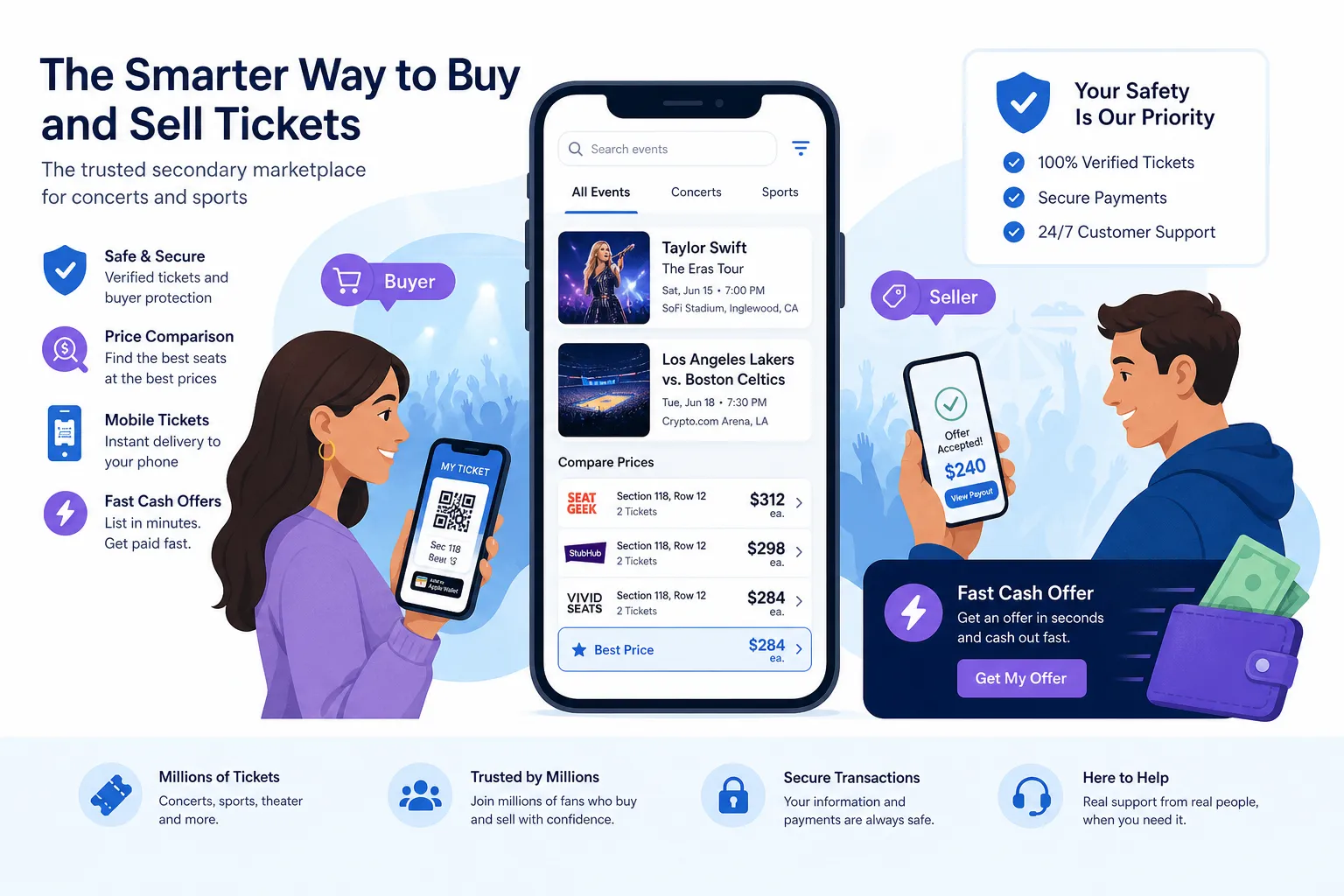
For buyers, the process usually looks like this:
Search for the event
Compare seat locations and prices
Review delivery method
Purchase through a resale platform or exchange
Receive mobile transfer, PDF, wallet pass, or account-based delivery
For sellers, there are usually two paths:
Traditional marketplace route
You create a listing, set a price, wait for a buyer, pay fees, deliver the tickets, and eventually get paid.
Direct-sale route
A company buys the tickets from you directly.
This is where WeBuyTickets stands out. Instead of forcing you into a listing process, WeBuyTickets gives you an instant offer within minutes, lets you submit in about 60 seconds, and pays through PayPal or Venmo in minutes after transfer. There is no listing required, no seller fees, no waiting for buyers, and no guesswork about whether your tickets will sell before event time.
If your priority is maximum convenience, especially for last-minute plans, that guaranteed-sale model is often the smarter option.
Who Uses the Secondary Market Most
The secondary market is not just for scalpers or desperate buyers. It is used by normal people every day, including:
concert fans chasing sold-out tours
sports fans buying rivalry, playoff, or weekend games
parents buying family seats together after the initial rush
season ticket holders unloading games they cannot attend
travelers making spontaneous event plans
last-minute sellers who need fast cash and certainty
That last group is especially important. A lot of competitors explain how to buy resale tickets, but they do not really solve the seller's biggest problem: speed. If your event is tonight, a listing may be too slow. WeBuyTickets is built for exactly that scenario.
Why Prices in the Secondary Concert Ticket Market Change So Much
This is one of the most misunderstood parts of secondary market concert tickets and sports resale.
Prices usually move because of six main factors.
1. Supply and demand
If thousands of people want 500 available seats, prices rise. If inventory is heavy and interest cools, prices fall.
2. Seat quality
Front row, lower bowl, club access, aisle seats, shaded sections, and center-stage views usually command premiums.
3. Event importance
A normal regular-season game behaves differently than a playoff clincher. An opening-night tour stop behaves differently than a third added date.
4. Timing
Prices can drop close to event time if sellers get nervous. They can also spike if inventory dries up.
5. Artist, team, or news cycle momentum
A team gets hot. A player returns from injury. A concert goes viral on TikTok. A surprise guest is rumored. Demand can shift fast.
6. Ticket format and transfer rules
Mobile-only, app-restricted, delayed delivery, or non-transferable setups can affect market liquidity and price.
Why Some Resale Tickets Are Below Face Value
One big content gap in competitor articles is that they mention this, but do not explain it well.
Tickets can drop below face value when:
the event is underselling
bad weather affects outdoor attendance
too many sellers list similar sections
the home team is struggling
the date conflicts with another major local event
sellers would rather recover something than nothing
event time is close and unsold tickets become a loss
So if you see secondary concert tickets below face value, that does not automatically mean something is wrong. It may simply mean the market softened.
When Buyers Usually Get the Best Deals
There is no universal best time, but there are patterns.
Timing Window | What Usually Happens | Buyer Opportunity |
|---|---|---|
Right after onsale | Hype is highest, many speculative listings appear | Good for securing access, not always lowest price |
Weeks before event | Market settles, inventory broadens | Often strongest comparison window |
1–3 days before event | Sellers react to demand and urgency | Can be a bargain or a squeeze |
Same day | High volatility, limited delivery flexibility | Best only for flexible buyers |
For buyers, the best move is rarely panic. Compare comparable sections, check transfer rules, and watch price movement if you have time.
For sellers, waiting can be risky. If you cannot attend, certainty matters. WeBuyTickets gives you a fast exit without hoping demand improves.
How to Buy Secondary Market Sports Tickets More Confidently
Sports resale has its own rhythm. Demand often depends on matchup quality, standings, star players, weather, and playoff implications.
When buying secondary market sports tickets, check these first:
Opponent quality
Big rivals and marquee teams drive prices up.
Day and time
Weekend and primetime games usually cost more than weekday games.
Weather and venue type
Outdoor events can soften in bad forecasts. Indoor events are usually steadier.
Team performance
Winning streaks create price pressure. Losing streaks can open value.
Seat location details
For baseball, think sun and shade. For football, sight lines matter more. For basketball and hockey, angle and proximity can outweigh row number.
How to Buy Secondary Market Concert Tickets More Safely
Buying resale does not have to feel risky if you use a clear checklist.
Stick to platforms with buyer protections
Use services that clearly explain refunds, ticket authenticity support, and delivery guarantees.
Review the delivery method
Look for mobile transfer, app transfer, or secure digital delivery. Understand whether you need an account with a specific ticketing app.
Check transfer timing
Some tickets are not released until days before the event. That is normal for many tours.
Read seating details closely
Partial view, side stage, standing room, wheelchair companion seating, and age restrictions matter.
Avoid deals that seem unrealistically cheap
Extreme underpricing can be a red flag, especially for high-demand events.
Confirm venue rules
Some events use named tickets, rotating barcodes, or phone-only entry.
Red Flags Buyers Should Never Ignore
Competitors touch on scams, but here are the most practical warning signs in one place:
Red Flag | Why It Matters |
|---|---|
Seller wants payment off-platform | Removes buyer protection |
Screenshot-only ticket claims | Many venues reject static screenshots |
No clear transfer method | Increases delivery risk |
Pressure tactics like “buy in 5 minutes” | Common scam behavior |
Price far below every comparable listing | Often bait |
Refusal to show order details or proof of ownership | Possible fake inventory |
Vague seat descriptions | Can hide restricted views or invalid listings |
Official Resale vs Unofficial Resale
Not all resale channels are equal.
Official resale
Usually integrated with the original ticketing system. Transfers are often cleaner and authenticity checks are stronger.
Unofficial resale
Can still be legitimate, but buyer protections vary widely. You need to vet terms, support responsiveness, and delivery standards more carefully.
For sellers, unofficial marketplaces also tend to mean more work: creating listings, choosing prices, absorbing fees, and waiting.
That is another reason many frustrated sellers skip the marketplace route entirely and use WeBuyTickets instead. You get a fair direct offer, a guaranteed sale, and responsive support without the usual friction.
The Real Tradeoff: Highest Possible Price vs Fastest Guaranteed Sale
This is where most guides fall short. They talk about price, but not enough about outcomes.
Here is the honest comparison:
Option | Potential Upside | Main Downside |
|---|---|---|
List on marketplace | You might get a higher price | No guarantee of sale, fees, delays, buyer risk |
Sell direct to WeBuyTickets | Speed, certainty, no listing, no seller fees, quick payout | You are choosing convenience over auction-style waiting |
If you are a seller with time, patience, and a desirable event, testing the market might make sense.
If you are short on time, tired of listing platforms, or need money quickly, WeBuyTickets solves the bigger problem: turning unused tickets into cash now.
Why Last-Minute Sellers Need a Different Strategy
A last-minute seller should not follow the same advice as a seller with three weeks to spare.
If your event is today or tomorrow, your priorities change:
you need certainty, not visibility
you need speed, not listing optimization
you need payment fast, not after the event
you need support if transfer rules are confusing
That is why WeBuyTickets is built around instant offers within minutes, support up to event start time, and fast payment via PayPal or Venmo. Instead of hoping a buyer shows up in time, you can lock in a straightforward sale.
Common Myths About Secondary Market Tickets
Myth 1: Resale always means overpaying
Not true. Many resale tickets fall to face value or lower when demand cools.
Myth 2: More expensive always means better
Usually, but not always. Some sellers simply price aggressively.
Myth 3: Waiting always gets the best deal
Sometimes. Other times inventory shrinks and prices jump.
Myth 4: All resale platforms work the same
They do not. Fees, support, delivery systems, and guarantees vary a lot.
Myth 5: Selling tickets yourself is always better
Only if your time, uncertainty, and seller fees do not matter. For many people, convenience wins.
A Smarter Buyer Checklist
Before buying any secondary market ticket, run through this list:
compare similar sections, not just total prices
verify delivery method and account requirements
check whether the ticket is transferable now or later
read notes for restricted view or standing room terms
understand refund or support policies
confirm event date, start time, and venue location
avoid off-platform payment requests
A Smarter Seller Checklist
If you need to sell unused tickets, ask yourself:
Do I have time to create and manage a listing?
Am I willing to wait for a buyer?
Do I want to risk the event getting closer and demand dropping?
Am I okay paying seller fees?
Do I need cash today?
If the answer points to speed and simplicity, WeBuyTickets is the practical choice. You submit ticket details in about a minute, get an AI-powered offer within minutes, transfer the tickets, and get paid fast. No listing. No waiting. No marketplace drama.
Best Practices for Buyers and Sellers at a Glance
Situation | Best Move |
|---|---|
Sold-out concert and you want in | Use trusted resale options and compare sections carefully |
Team just clinched playoffs | Expect fast price movement and limited premium inventory |
You have extra tickets weeks in advance | Compare your options early before urgency kicks in |
You cannot attend and event is soon | Sell directly to WeBuyTickets for speed and certainty |
You hate fees and managing listings | Use a direct buyer model |
You need money before the event starts | Choose instant-offer resale over waiting for a marketplace buyer |
What Competitor Guides Missed
After reviewing competing content, a few gaps stand out:
They focus heavily on buyers, not sellers
Real people also need a fast, low-stress way to unload tickets.
They explain resale, but not decision-making
The key question is not just “what is the secondary market?” It is “when should I buy, when should I wait, and when should I sell now?”
They underplay convenience economics
Time has value. So does certainty. So does avoiding fees.
They rarely address last-minute selling well
This is one of the biggest real-world pain points, and it is where WeBuyTickets brings clear value.
Final Verdict
The secondary ticket market is not automatically risky or overpriced. It is simply a flexible marketplace where prices change based on demand, timing, seat quality, and event importance.
For buyers, the smartest approach is to compare carefully, understand delivery rules, and use platforms with real protections. For sellers, the biggest decision is whether you want to wait for a buyer or get a guaranteed sale now.
If your plans changed and you want the fastest, simplest way to turn unused tickets into cash, WeBuyTickets is the shortcut. You get an instant offer within minutes, no listing requirements, no seller fees, fast PayPal or Venmo payment, and support even when the event is close. When convenience, speed, and certainty matter more than playing the marketplace game, that is hard to beat.
FAQ
How does the secondary ticket market work?
The secondary market is where tickets are resold after the original purchase. Buyers shop tickets listed by fans, season ticket holders, brokers, or resale services, while sellers either list them on a marketplace or choose a direct-sale option like WeBuyTickets for a fast guaranteed offer.
How to buy second hand tickets safely?
Buy through platforms with clear buyer protections, secure digital delivery, and responsive customer support. Always check the seat details, transfer method, and venue entry rules before paying.
How to avoid getting scammed when buying tickets?
Avoid sellers who ask for off-platform payment, send only screenshots, or price tickets far below comparable listings. Stick to verified platforms, confirm the transfer process, and never let urgency push you into skipping the details.