Concert Ticket Pricing: Fees, Trends, and Timing
Published September 14, 2026
Learn concert ticket pricing, fees, and timing so you can buy smarter, track price trends, and sell fast with confidence today.
Concert Ticket Pricing: Fees, Trends, and Timing
Concert ticket prices can feel confusing for one simple reason: the number you see first is often not the number you actually pay. Between tiered pricing, dynamic demand, resale markups, and concert ticket fees added at checkout, the final total can jump fast.
If you are trying to buy smarter, or sell extra tickets without getting stuck in a slow marketplace, the good news is that ticket behavior follows patterns. Once you understand how concert ticket pricing works, you can make better calls on when to buy, when to wait, and when to cash out tickets you can no longer use.
Why concert ticket prices feel higher than expected
Most fans experience ticket shock in two stages:
The base ticket price looks manageable.
The total at checkout is much higher.
That jump happens because modern pricing is layered. A concert seat is not just priced by row anymore. It is shaped by demand, inventory scarcity, artist popularity, venue size, add-ons, and platform fees.
The four biggest drivers of concert ticket pricing
1. Demand
If a major artist has a limited number of dates and a huge fan base, prices climb quickly. High-demand tours often sell through fast, which pushes both primary and secondary market prices upward.
2. Tiered seating
Not every seat is priced the same. Front-row, lower bowl, aisle, club access, and VIP packages all separate buyers by willingness to pay.
3. Dynamic pricing
Some sellers now adjust prices in real time. If demand surges, prices can jump even before the event sells out.
4. Fees
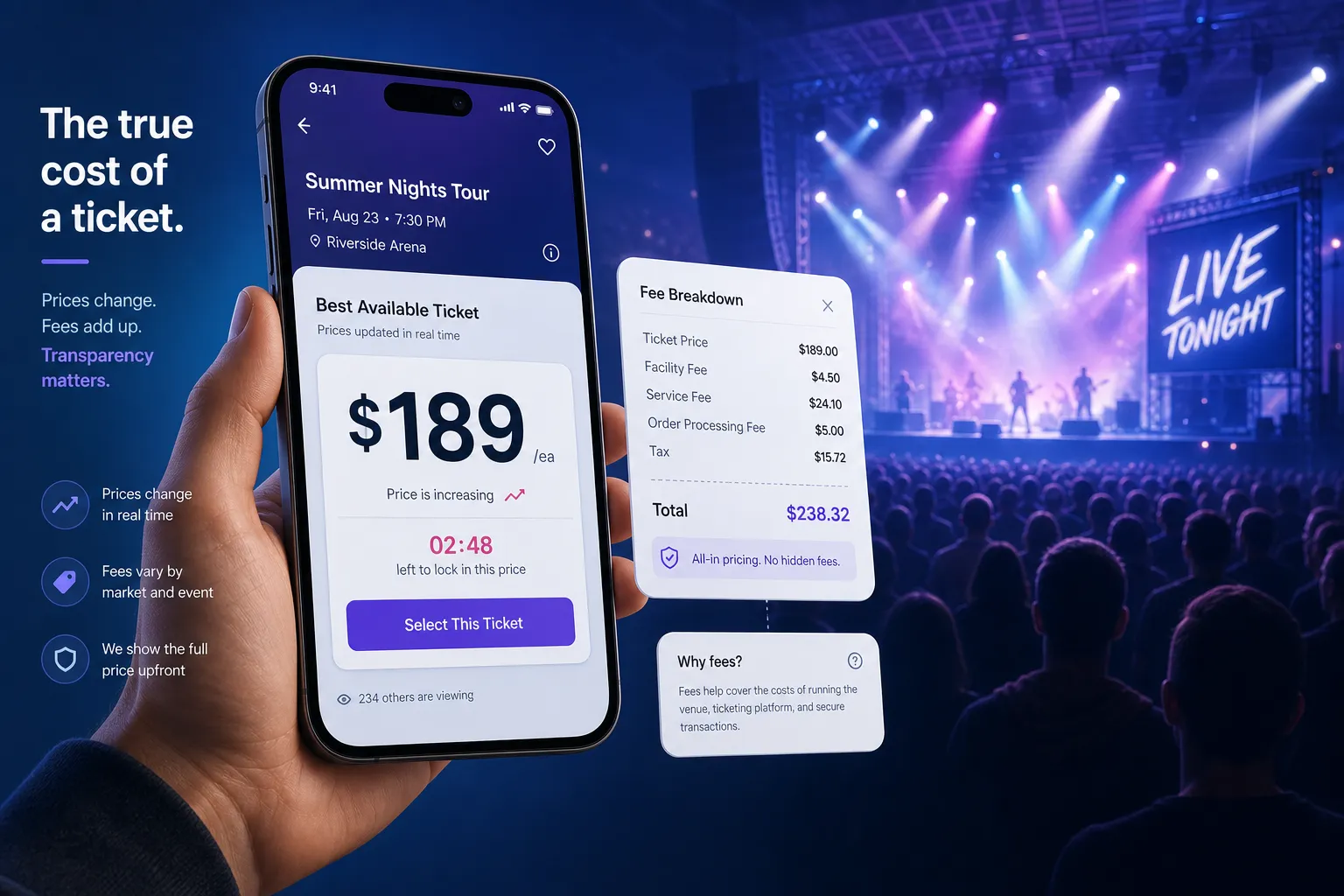
This is the part many buyers underestimate. Concert ticket fees can include service charges, facility fees, processing costs, delivery charges, or resale platform fees.
What concert ticket fees actually include
Concert ticket fees are often the least transparent part of the process. They vary by platform, venue, and delivery method, but usually fall into a few categories.
Fee Type | What It Usually Covers | Why It Matters |
|---|---|---|
Service fee | Platform operations, ticketing infrastructure | Often the biggest add-on |
Processing fee | Payment handling and order administration | Can appear late in checkout |
Facility fee | Venue-related operating costs | Usually fixed per ticket |
Delivery fee | Mobile transfer or fulfillment | Sometimes charged even for digital tickets |
Resale fee | Marketplace commission and buyer charges | Raises total cost significantly |
Why fees matter more than fans think
Two tickets with the same listed price can end up with very different totals depending on where you buy. That is why smart buyers compare the out-the-door cost, not just the number shown on the event page.
A common mistake is to focus only on face value. The real comparison point is:
Base Price + Fees + Taxes + Delivery = True Cost
How concert ticket prices change over time
One of the biggest questions fans ask is whether they should buy now or wait. The answer depends on the event.
Some shows get more expensive as inventory disappears. Others soften closer to showtime if sellers get nervous and try to unload unsold seats.
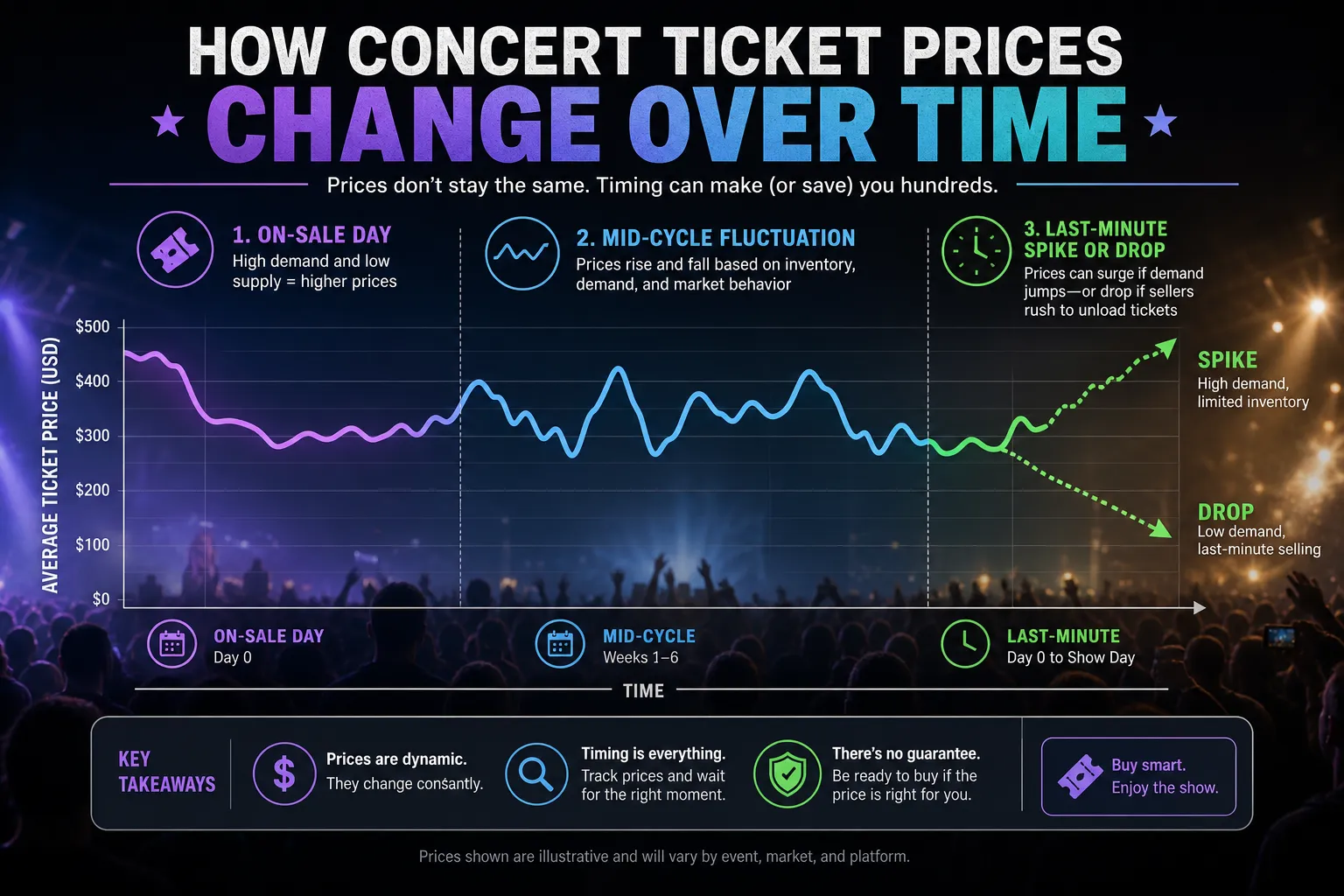
A simple timeline of ticket price movement
On-sale period
Prices may start at face value, but high-demand inventory disappears quickly. If dynamic pricing is active, some seats can rise immediately.
Early resale window
Resellers list aggressively, often above what the market will bear. This is where prices can look inflated.
Mid-cycle
As more inventory appears, some prices stabilize. For less-hyped shows, this can be a useful buying window.
Final week
Prices become more volatile. Strong-demand events may spike. Weak-demand events may drop.
Day of show
This is the highest-risk, highest-opportunity window. Great deals can appear, but so can scarcity.
The biggest trends shaping modern concert ticket pricing
Competitor coverage usually talks about prices going up, but the bigger story is how pricing has changed. It is no longer just “tickets are expensive.” The market is more segmented, more reactive, and more data-driven.
Trend 1: More aggressive premium pricing
Artists and promoters increasingly protect cheap entry points while charging much more for the best inventory.
Trend 2: Wider price gaps inside the same venue
The spread between nosebleeds and premium sections is larger than it used to be.
Trend 3: VIP bundling
Merchandise, lounge access, early entry, and meet-and-greet packages have expanded the top end of the market.
Trend 4: Dynamic demand response
More events adjust pricing based on real-time buyer behavior, not just a fixed seating chart.
Trend 5: Better consumer tracking tools
Fans can now track concert ticket prices more easily across platforms, which makes bad timing less necessary.
What most articles miss: cheap tickets and expensive tickets can both exist at the same time
This is one of the most important content gaps in typical coverage. Many articles talk about average prices rising, but that can hide what is really happening inside a venue.
Often, the cheapest seats do not rise nearly as fast as the premium ones. That means two things can be true at once:
Front sections may become dramatically more expensive
Budget seats may remain relatively available
For buyers, that means flexibility matters more than ever. If your goal is simply to get in the building, patience and section discipline can pay off. If your goal is a premium experience, waiting can backfire.
When to buy concert tickets based on the type of event
There is no universal rule. The best timing depends on demand profile.
Best buying strategy by event type
Event Type | Best General Approach | Risk of Waiting |
|---|---|---|
Stadium superstar tour | Buy early if you need specific seats | High |
Arena show with many dates | Monitor and compare over time | Medium |
Mid-level artist in large venue | Wait for mid-cycle softening | Medium |
Weeknight local concert | Watch for last-minute drops | Low to medium |
Festival or one-night-only event | Buy early if attendance is essential | High |
Buy early when:
The artist is massive
It is a one-night stop
You need seats together
You want premium or floor inventory
The market is already moving fast
Wait when:
Inventory looks deep
The venue is large relative to demand
There are multiple nearby dates
Resale listings are clustered at unrealistic prices
You are flexible on section and row
How to track concert ticket prices without overpaying
If you want to track concert ticket prices effectively, do not just refresh one marketplace and hope for the best. Watch the market more strategically.
What to monitor
Total price, not list price
Always compare checkout totals where possible.
Inventory depth
If many similar seats remain, sellers may cut prices later.
Section-specific movement
A dropping upper bowl does not mean floor seats are falling too.
Timing to event
The closer the date gets, the more emotional sellers become.
New supply
Production holds, late releases, or season-ticket holder listings can change the market fast.
A practical framework for smarter ticket buying
Use this quick decision framework before purchasing:
Situation | Smart Move |
|---|---|
Prices are rising daily and inventory is thin | Buy now |
Inventory is heavy and listings are stagnant | Wait |
You need 4+ seats together | Buy earlier |
You only need 1 or 2 seats and are flexible | Consider waiting |
It is a bucket-list show | Prioritize certainty over chasing the lowest possible price |
Why resale sellers lower prices at the last minute
This is where buyer strategy and seller pain points collide.
Traditional marketplaces force sellers to:
Create listings
Guess the right price
Wait for a buyer
Compete against thousands of other sellers
Absorb seller fees
Hope the tickets sell before the event starts
That pressure is exactly why some last-minute deals appear. Sellers would rather recover something than let tickets go unused.
But if you are the seller, this system is stressful. And if the event is close, it can become a race against time.
The easier alternative for sellers: guaranteed speed over marketplace uncertainty
If you have extra concert tickets and need to sell fast, waiting for the “perfect buyer” is not always the smartest move. Sometimes the best outcome is a fast, fair, guaranteed sale.
That is where WeBuyTickets stands out.
Instead of listing your tickets and hoping someone buys them, WeBuyTickets buys directly from you. There is no marketplace listing to manage, no pricing guesswork, no seller fees, and no waiting around while the event gets closer.
How WeBuyTickets works
Submit your ticket details in about 60 seconds
Receive an AI-powered offer within minutes
Transfer the tickets
Get paid through PayPal or Venmo shortly after
That model is built for convenience. It is especially useful for:
Last-minute sellers
Fans who can no longer attend
Season ticket holders with extra inventory
Anyone tired of slow resale platforms
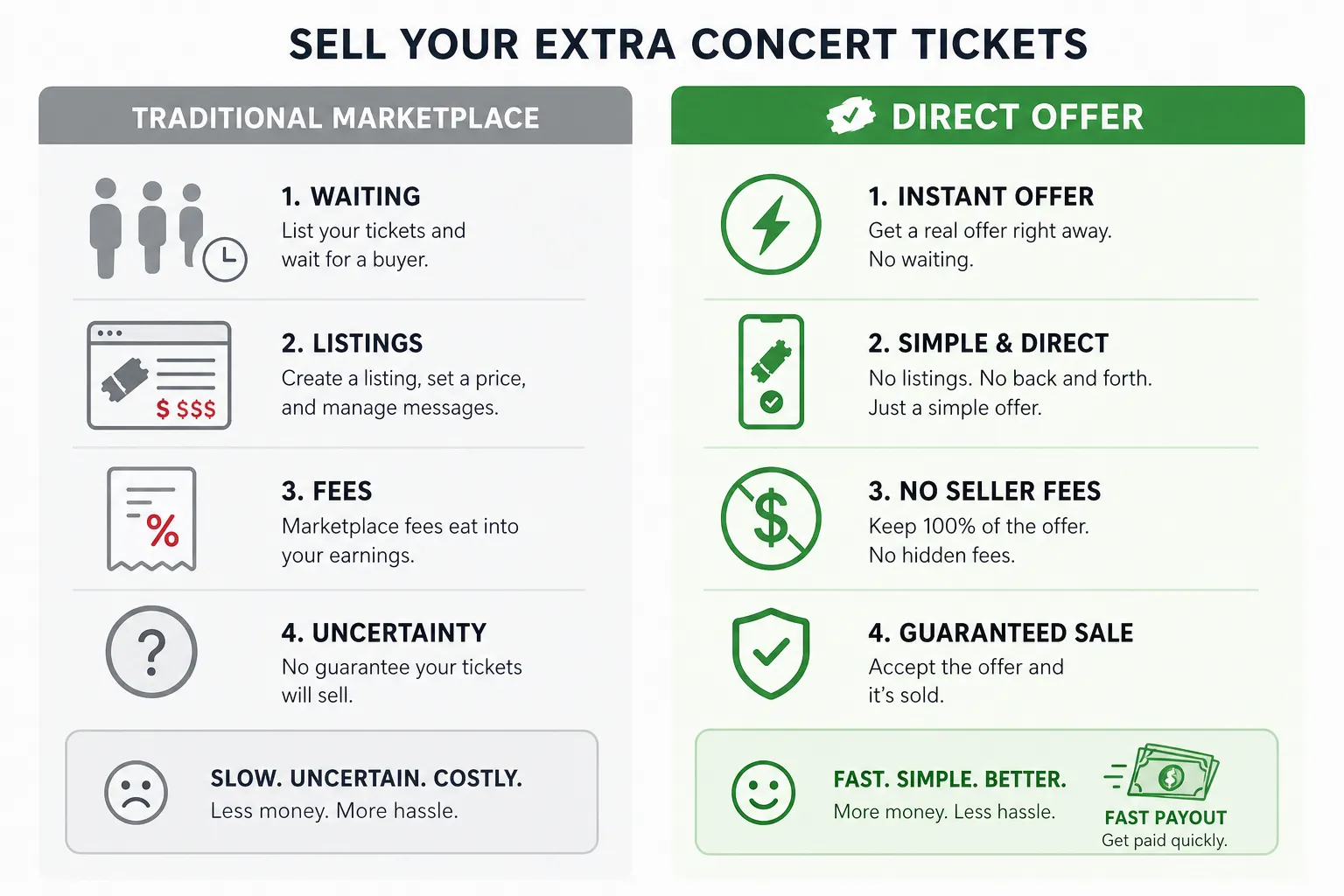
WeBuyTickets vs traditional marketplaces
Feature | WeBuyTickets | Traditional Marketplace |
|---|---|---|
Need to create a listing | No | Yes |
Wait for a buyer | No | Yes |
Seller fees | No seller fees | Usually yes |
Pricing uncertainty | Low | High |
Payment speed | Minutes after transfer via PayPal or Venmo | Often delayed |
Last-minute support | Yes, even close to event time | Limited by demand and listing window |
Sale guarantee | Yes, if offer accepted and transfer completed | No |
Why sellers use WeBuyTickets for last-minute events
The closer an event gets, the more painful traditional resale becomes. Listings can get buried. Price cuts can snowball. Support can be slow. And there is always the risk of ending up with nothing.
WeBuyTickets removes those friction points with a direct-buy model designed for speed and simplicity.
That matters when:
Plans changed the same day
You are holding unused season tickets
You want cash now, not later
You do not want to babysit a listing
You would rather take a fair guaranteed offer than gamble
Use price tracking to buy smarter, and a direct offer model to sell faster
Here is the simplest way to think about the market:
As a buyer: track trends, compare total prices, and time your purchase based on demand.
As a seller: do not let unused tickets turn into a zero-value asset while you wait for a marketplace miracle.
If you can no longer attend an event, speed matters. A guaranteed offer in minutes is often better than chasing a theoretical higher payout that may never happen.
Tools that help fans see the market more clearly
If your goal is to understand pricing behavior before you buy or sell, market-tracking platforms can help you spot movement over time.
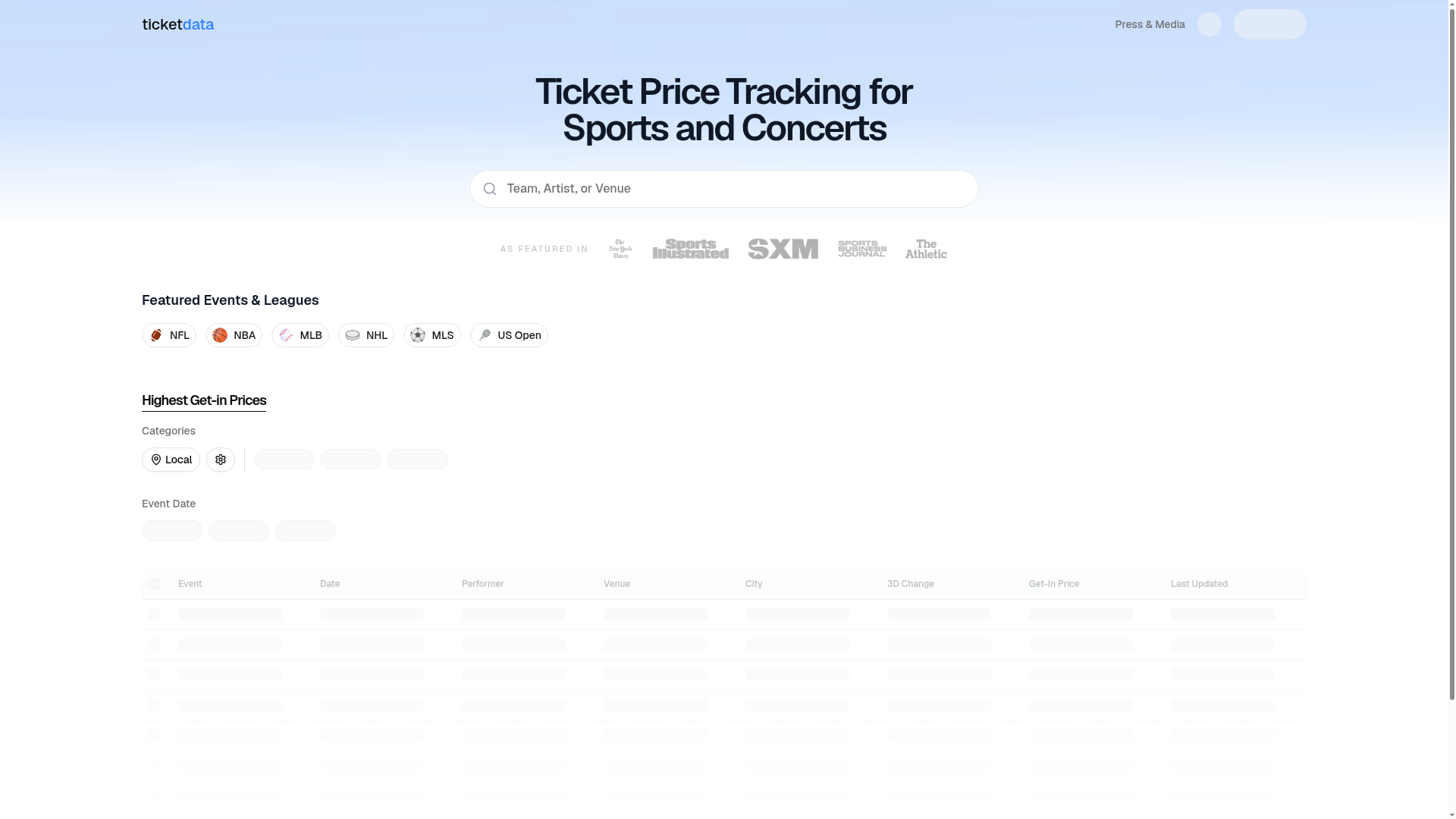
A ticket tracking site like TicketData can help fans monitor get-in prices, short-term movement, and event-level trends. That visibility is useful if you want to avoid buying at a temporary peak or understand whether the market is tightening.
A smarter final verdict on concert ticket pricing
Concert ticket prices are not random. They move based on demand, seating quality, timing, inventory, and fees. The smartest buyers focus on total cost, watch how inventory shifts, and stay flexible when the market allows it.
And if you are on the selling side, convenience matters just as much as price. Traditional marketplaces can be slow, uncertain, and fee-heavy. WeBuyTickets offers a simpler path: a 60-second submission, an instant offer within minutes, no listing required, no seller fees, fast PayPal or Venmo payment, and support even for last-minute sales close to event start time.
If you need to turn unused tickets into cash without the hassle, WeBuyTickets is the fast, trusted option built for exactly that moment.
FAQ
Do concert ticket prices get cheaper closer to the date?
Sometimes, but not always. Lower-demand shows may drop closer to the event as sellers try to avoid losing everything, while high-demand concerts often get more expensive as inventory disappears.
Do ticket prices go down an hour before a concert?
They can, especially if sellers are desperate to move unsold tickets. But this is a high-risk strategy because inventory may also dry up or only poor seats may remain.
Do Ticketmaster prices go down the day of the show?
Sometimes, but it depends on the event and whether dynamic pricing is active. For strong-demand shows, day-of prices may stay high or rise, while softer events can see late price relief.
What is the best time to buy cheap concert tickets?
The best time is usually when inventory is still healthy but early hype has cooled. For many events, that means monitoring the mid-cycle window instead of buying immediately or waiting until the last minute.
Is it better to buy concert tickets right away or wait?
Buy right away if the artist is huge, the event is a one-night stop, or you need specific seats. Wait if the venue is large, listings are plentiful, and you are flexible on section and timing.